
Someone once asked me how I was doing, not in the passing, rhetorical way, but in the actual way, the sitting-forward way, the way that requires a real answer. And I found, to my surprise, that I didn't have one.
Not because nothing was wrong. But because I had been operating in a state of low-grade, background-hum tension for so long that I had completely lost the ability to assess it. The question assumed I had a reference point. I didn't. I had no idea what fine felt like from the inside anymore, because the last time I had felt genuinely, quietly fine, not performing fineness, not pushing through to the other side of some difficulty, but simply at rest inside my own life, was so long ago I couldn't locate it.
I remember sitting there trying to find the answer and coming up empty. Not distressed. Not in crisis. Just blank on the question of my own baseline. Which, when I think about it now, was itself the answer.
"I've been a holistic therapist for 20 years and I'd read every stress book on the market. This was the first one that gave me language for what was happening inside my own body."
Sarah Barton, Holistic TherapistI found that observation in a testimonial from Sarah Barton, one of my own clients, and felt the specific recognition of seeing a shared experience named so precisely. That is exactly it. Exactly the thing that had been happening for years before I had the language for it.
Not a dramatic collapse. Not a crisis. Just a slow, invisible migration away from a baseline I could no longer remember until the baseline itself had been so thoroughly replaced by tension that the tension stopped registering as anything at all.

The Stress That Hides by Becoming Normal
We tend to think of stress as something we notice. Something that arrives with force and announces itself, a racing heart, a specific dread, a recognisable anxiety. And for some people, some of the time, that is how it works.
But there is another kind entirely. The kind that doesn't announce itself because it has been present for so long that it has become indistinguishable from personality. From baseline. From just the way things are and the way you are and the way life is and has always been.
This is the stress that accumulates in women who have been carrying more than they've been given credit for, often for years, sometimes for decades. It builds slowly, in layers, each layer thin enough to adapt to. The adaptation is so efficient, so automatic, that the woman doing it often doesn't experience it as adaptation at all. She experiences it as life. As normal. As herself.
And so the signals go unread. Not because she isn't intelligent or self-aware, often these are the most intelligent, most self-aware women you will meet. But because you cannot read signals against a background that has become the signal. When tension is your baseline, there is no contrast.

The same pattern appears in nearly every woman I've worked with: the longer she's been carrying chronic stress, the less likely she is to call it stress. She calls it her personality. She calls it being a mother. She calls it perimenopause. She calls it Tuesday.
The body adapts so efficiently that she stops feeling the load. And that is the most dangerous stage because that is when the warning system goes quiet.
This is why the standard advice, "notice when you're stressed and take a break", is so profoundly useless for the women who need help most. You cannot notice what you've stopped being able to see. You cannot take a break from a state you've stopped registering as anything other than how you are.
The Hundred Small Things She'd Stopped Questioning
When stress normalises, it doesn't produce one obvious symptom. It produces dozens of quiet ones that spread through every corner of daily life, physical, emotional, cognitive, behavioural, each one individually explainable as something else entirely. A bad night. A difficult week. Perimenopause. Getting older. Being someone who just doesn't have a lot of energy.
Here is what normalised chronic stress looks like from the inside, the signs the women I work with have carried so long they had entirely stopped seeing them as signs:
- Waking at 3am with the mind already racing, called it "just how I sleep now"
- A mind that kept running even during rare moments of stillness, called it "having an active brain"
- Needing days to recover from social events that used to feel easy, called it "introversion"
- A persistent low-level irritability that spiked at small, random triggers, called it "impatience" or "hormones"
- Free time that felt like pressure rather than relief, called it "being bad at relaxing"
- Guilt every time she sat down without a task to justify the sitting, didn't call it anything; assumed everyone felt it
- Jaw clenching, tension headaches by 2pm, called it "stress at work"
- A flatness in activities that used to bring real pleasure, called it "adulting" and moved on
- Difficulty finishing things that used to come easily, called it "brain fog" or "perimenopause"
- An absence of the feeling she remembered as peace, didn't call it anything because she'd stopped expecting it

That last one. Stopped expecting it. The moment a woman stops expecting to feel calm, stops even remembering that calm is something available to her, is the moment normalisation is complete.
She didn't lose herself dramatically. She lost herself the way you lose an hour, gradually, without noticing, until you look up and the light has changed completely.
From 25 years of holistic experience"We hear the word 'stress' all the time, yet it's such an umbrella term. Beverley breaks it down into 300 signs, allowing you to take action once you notice the first signs. I loved the simple layout, a clear description, a practical solution, and a calming affirmation. A great book to have to hand!"
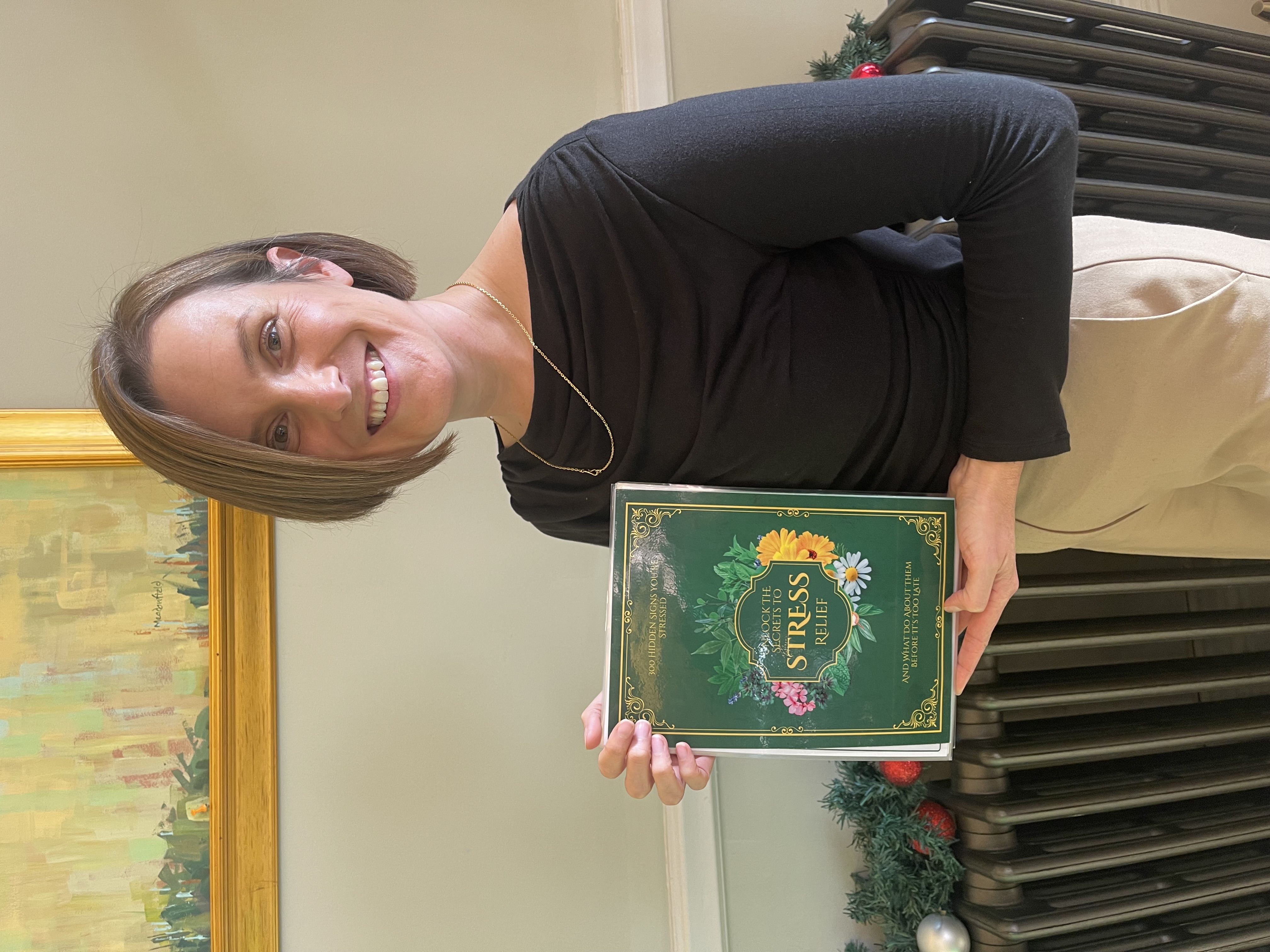
"I genuinely found this so helpful. The layout makes it incredibly easy to use, the abbreviated solutions in the clear boxes are perfect when you need quick answers. The home remedies are a brilliant bonus, and the size is perfect for my handbag so I can dip into it whenever I need a moment of calm. Highly recommend it!"
Why "Just Relax" Was the Least Useful Thing Anyone Said to Me
There is a particular cruelty in telling a woman with a chronically elevated nervous system to relax. Not intentional cruelty, the people who said it meant well, every single one of them. But functionally, the instruction to relax when you have normalised tension is like telling someone to turn left when the concept of left has become unavailable to them.
I tried. I tried in the ways people recommend. Meditation, which, for several years, produced nothing except an acute awareness of how loud and relentless my mind was. Long baths. Walks. Holidays that I planned so thoroughly that they were indistinguishable from work, right up until the moment they ended and the return dread set in.
None of it addressed the actual problem, which was not that I needed better relaxation techniques. It was that I had been in a state of chronic, accumulated, normalised overload for so long that I had lost my felt sense of what I was trying to relax toward.
"I feel physically, mentally, spiritually frozen and beaten down. I've been pushing through for so long I don't remember what it felt like before the pushing."
Alison Ward, verified reader
What was missing was not a better relaxation technique. It was something much more basic: the ability to read what was actually happening. To look at the hundred small signs that chronic stress produces and understand them as a connected pattern rather than a collection of unrelated personal quirks.
Because once you can see the pattern, once you have language for it, something changes. The shame dissolves. The self-blame loses its grip. And for the first time in a long time, the problem feels like a problem you might be able to do something about.
The Question Nobody Was Asking
The question that mattered, the one I hadn't been asked and hadn't thought to ask myself, was simpler and more unsettling than any of the usual ones.
When did you last feel genuinely, quietly calm?
Not happy. Not productive. Not fine-because-nothing-catastrophic-is-happening. Calm. The physical, embodied, bone-deep sense of not being braced. Of the next thing not already pressing in.
For many women, particularly the high-functioning, conscientious, relationally responsible women I've worked with over the years who have spent years carrying more than they've admitted to, the story of "this is just who I am" is not a story about personality. It is a story about adaptation. And adaptation, unlike personality, can be understood. Can be traced. Can, with the right tools, be gently and specifically addressed.
What Happens When You Finally Get the Language
A reader was working through the guide, Unlock The Secrets To Stress Relief and she stopped at sign number thirty-one. It described something she had been doing for years, something small and specific and slightly peculiar, something she had never mentioned to anyone because it didn't seem significant enough.
It was a stress signal. It had been, apparently, a stress signal for the entire time she'd been doing it. And in the moment of reading that, something very quiet happened, just a small, precise loosening. A sense of: oh. So that's what that was.
That loosening happened again at sign fifty-three. And at sign ninety-one. Each recognition made visible, with a specificity that no general stress resource had ever achieved, the pattern she had been living inside without being able to see.
And when you can see the pattern, when the hundred small things stop being a hundred separate problems and become one coherent signal, the overwhelm changes shape. It becomes, if not smaller, then at least more legible.
What's Actually Inside: Why It Feels Different From Everything Else You've Tried
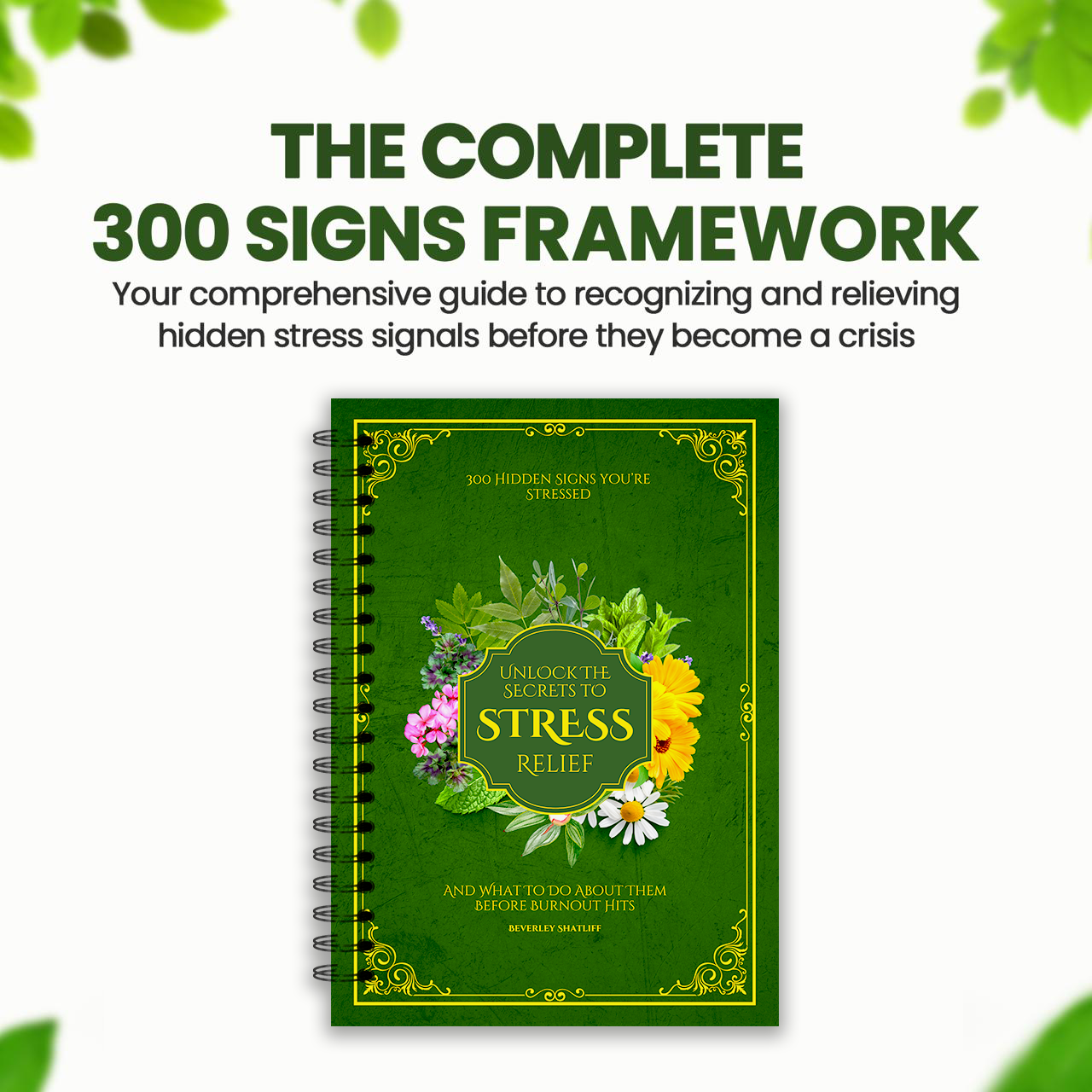
Unlock The Secrets To Stress Relief: 300 Hidden Signs You're Stressed And What To Do About Them Before Burnout Hits
Written by Beverley Shatliff, Stress Management Specialist, Reiki Master Teacher, Advanced Holistic Practitioner with 25 years of experience in holistic health. This is not a general wellbeing guide. It was built specifically for the woman who is still functioning, still managing, and still questioning whether what she's experiencing is "bad enough" to deserve attention.
It doesn't ask you to meditate twice a day, overhaul your morning, or add anything significant to your already-stretched life. It asks only that you start paying attention to what your body has been trying to tell you, in language you can finally understand.
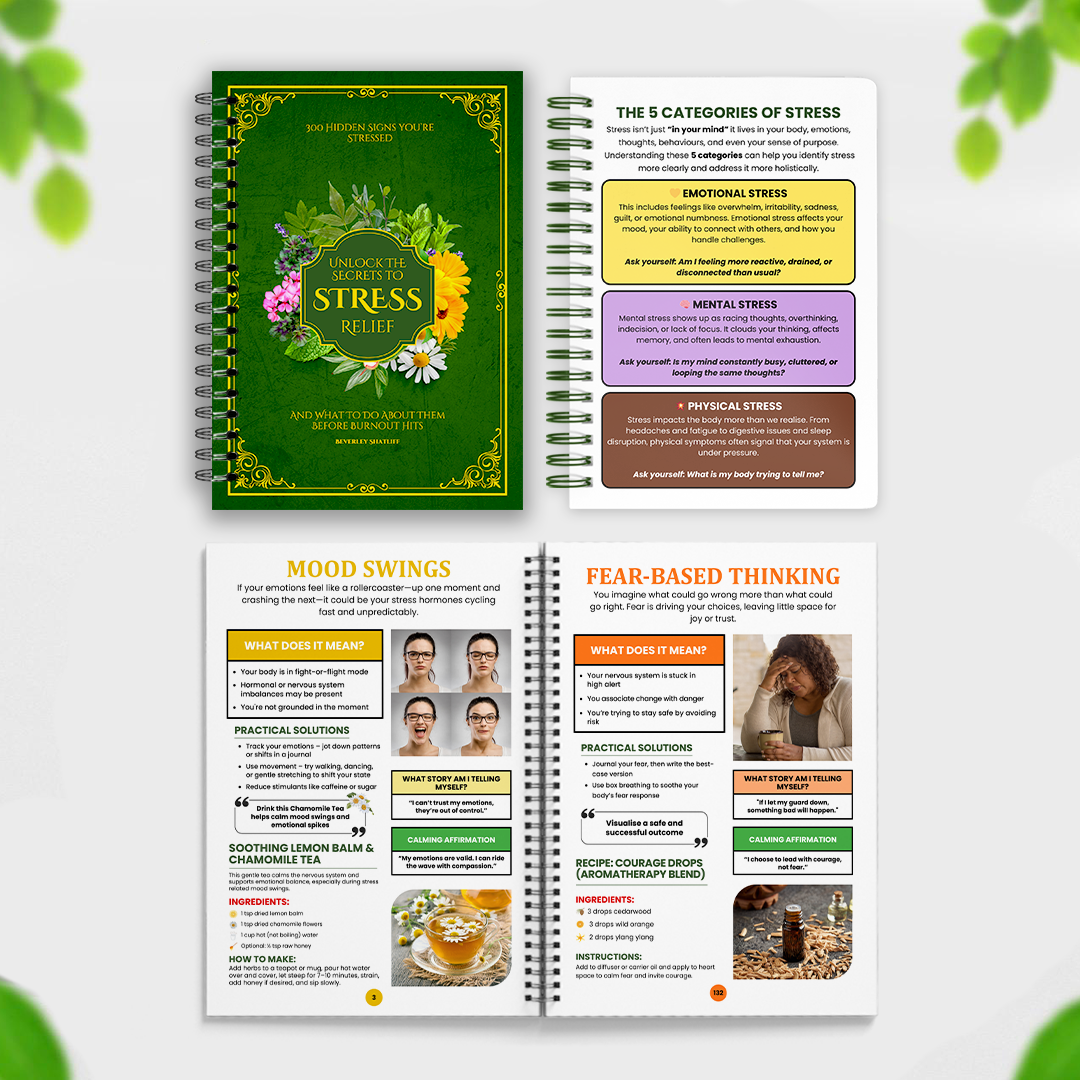
Most stress content is built around what stress is. This one is built around what stress looks like in your specific life, in the way you snap, the way you freeze, the way you go quiet, the way you stop enjoying the things you used to love.
The guide is organised around five categories of stress because stress doesn't just live in one place in the body. It spreads. And until you can see it in all five areas at once, you'll keep treating isolated symptoms while the pattern underneath keeps building.
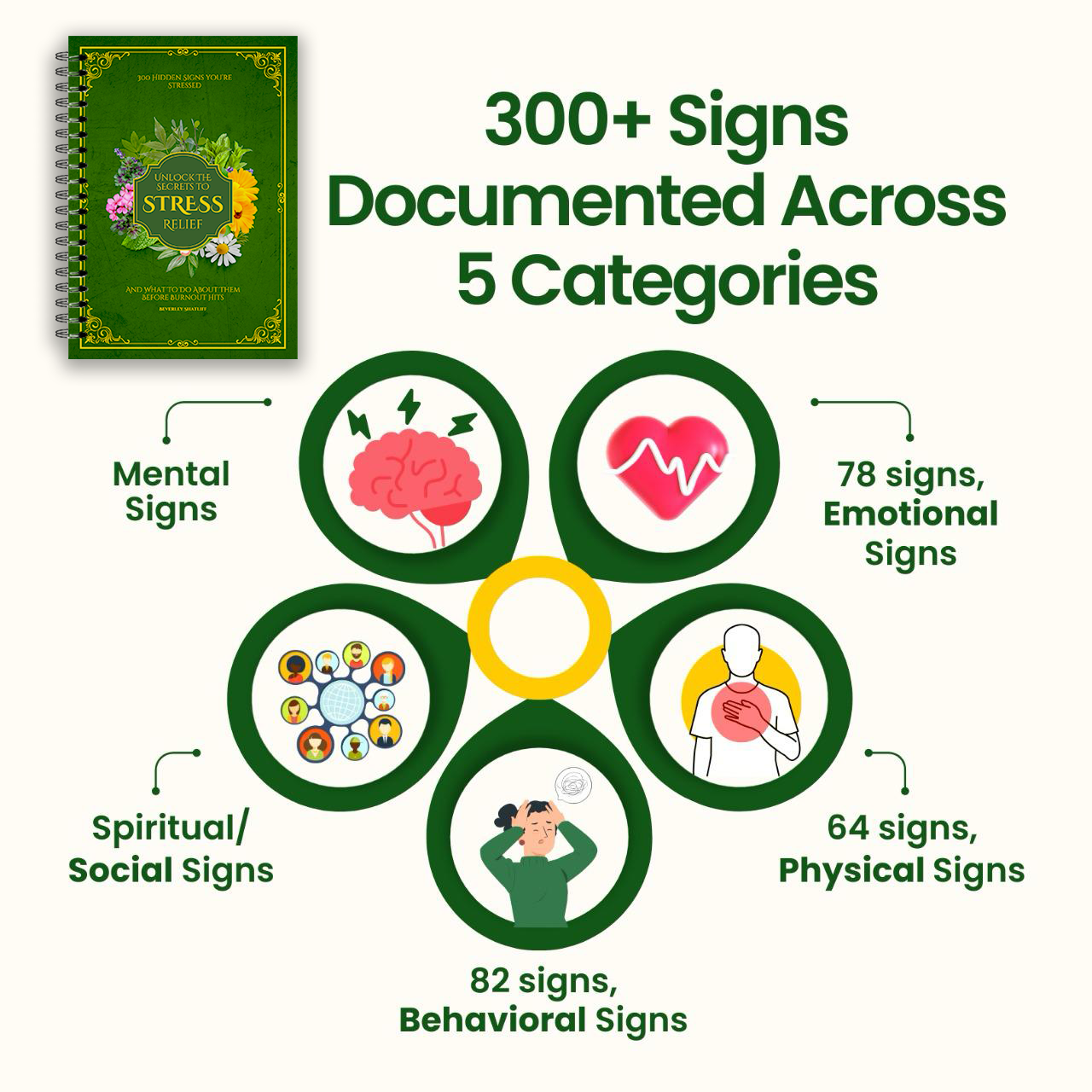
Racing thoughts, brain fog, forgetting words, inability to focus, the mind that never stops but can't actually think clearly.
Irritability, emotional flatness, numbness, snapping over small things, guilt when resting, feeling unlike yourself.
Exhaustion that sleep doesn't fix, jaw clenching, tension headaches, the exhaustion that lives in the bones.
Avoidance, scrolling instead of resting, the same meals on repeat, skipping texts, procrastinating on things that should be easy.
Feeling disconnected from your sense of purpose, withdrawing from people and things that once mattered, a hollowness that is difficult to name.
The framework Beverley uses is called the Signal to Soothe Method. The idea is disarmingly simple, and it's exactly what's missing from every other resource on this topic:
Step 1: Spot the signal. Recognise the hidden stress sign for what it actually is, not a character flaw, not laziness, not a hormonal issue. A signal.
Step 2: Name the overload. Understand what category of stress the sign points to, so you're responding to the actual source rather than the surface symptom.
Step 3: Soothe the system. Apply one small, appropriate relief action that interrupts the pattern, without adding another overwhelming task to your already-full life.
No complicated programme. No 90-minute daily routine. No perfection required. Just the ability to read what your body is telling you and respond to it, early, specifically, and without shame.
From women who work in this space themselves
"Absolutely love this book. It's a practical manual for identifying when you're stressed and a roadmap for what to do to care for yourself. I love the short, clear snippets combined with affirmations to self-regulate, and all the practical, simple recipes, remedies and teas. What an amazing achievement."
"As a holistic therapist, I found this book to be an enlightening and compassionate guide. Each entry is a mini-lesson in mindfulness and self-care, offering clear explanations, practical solutions, and soothing affirmations. A gentle guide back to oneself, a valuable resource for anyone on a journey of self-discovery and healing."
But What If You've Already Tried Everything?
This is the most common response from women who've been carrying hidden stress for years. They've read the books. They've tried the apps. They've downloaded the meditation, started the journal, considered the therapy, taken the holiday. And something either didn't stick, didn't help, or quietly added one more thing to fail at.
Knowing you're stressed and being able to see your stress clearly are two different things. This guide doesn't tell you something abstract about stress, it names the specific signs in your body, your behaviour, your relationships that you've been filing under personal failure for years. That shift, from "I'm bad at coping" to "I'm reading the signs now", is the thing that actually changes something.
This is precisely why the guide was designed the way it was. You don't read it front to back. You use it like a reference, turn to the area that feels most urgent, find the signs that match your experience, and choose one small thing to do about it. You can start with one sign. The whole philosophy is built around the reality that the reader is already exhausted.
You're right. No honest product would promise that. What this does is stop you carrying the invisible extra weight of self-blame, misread symptoms, and unrecognised overload on top of the real stressors. Most women in this pattern are fighting on two fronts, the actual external pressure, and the internal war of shame. Removing the second front changes the experience significantly.
The remedies in this guide come from 25 years of holistic experience. They're not a substitute for medical care, they're targeted, sign-specific relief actions, many drawing on traditional herbalism that has been used for centuries. Each one is matched to a specific signal, so you're not throwing generic advice at a generic problem. You're applying the right small thing to the right specific overload.
Honest answer: if it doesn't help, you get a full refund for 365 days. The risk is mine, not yours. The reason readers describe this one as different is that it doesn't ask for behaviour change before relief, it gives you recognition first, language second, and a small action third. Most stress products skip straight to step three. That's why they fail for women who don't even know they're in step one yet.
What Else Is Included, The Bonuses That Make This a Complete System
When you get the guide, you also receive five additional resources built specifically for the moments the main guide can't cover on its own. The honest version: the bonus materials are where a lot of readers say the most immediately useful things live.
A simple, personalised map that helps you identify which type of stress is most dominant for you right now and where to focus your energy first. Instead of working through 300 signs without direction, this gives you a clear starting point.
For the moments when you're already in it, the overstimulated, can't-think, everything-is-too-much moments. A short, practical emergency toolkit for getting yourself back from the edge when you need it now, not later.
How constant connectivity, notification culture, and the pressure to be always-on amplifies every other stress signal in your life and what to do about it without deleting your entire digital existence.
Not a 5am wake-up. Not a 90-minute ritual. A genuinely realistic, low-pressure morning framework designed for real life, that sets your nervous system up for the day instead of immediately throwing it into reactive mode.
The distilled version. If you only have twenty minutes and you want to know where to begin, this blueprint walks you through the six most impactful steps, in the right order, so you can start feeling clearer and calmer.
What Happens When You Can Finally Read the Signals
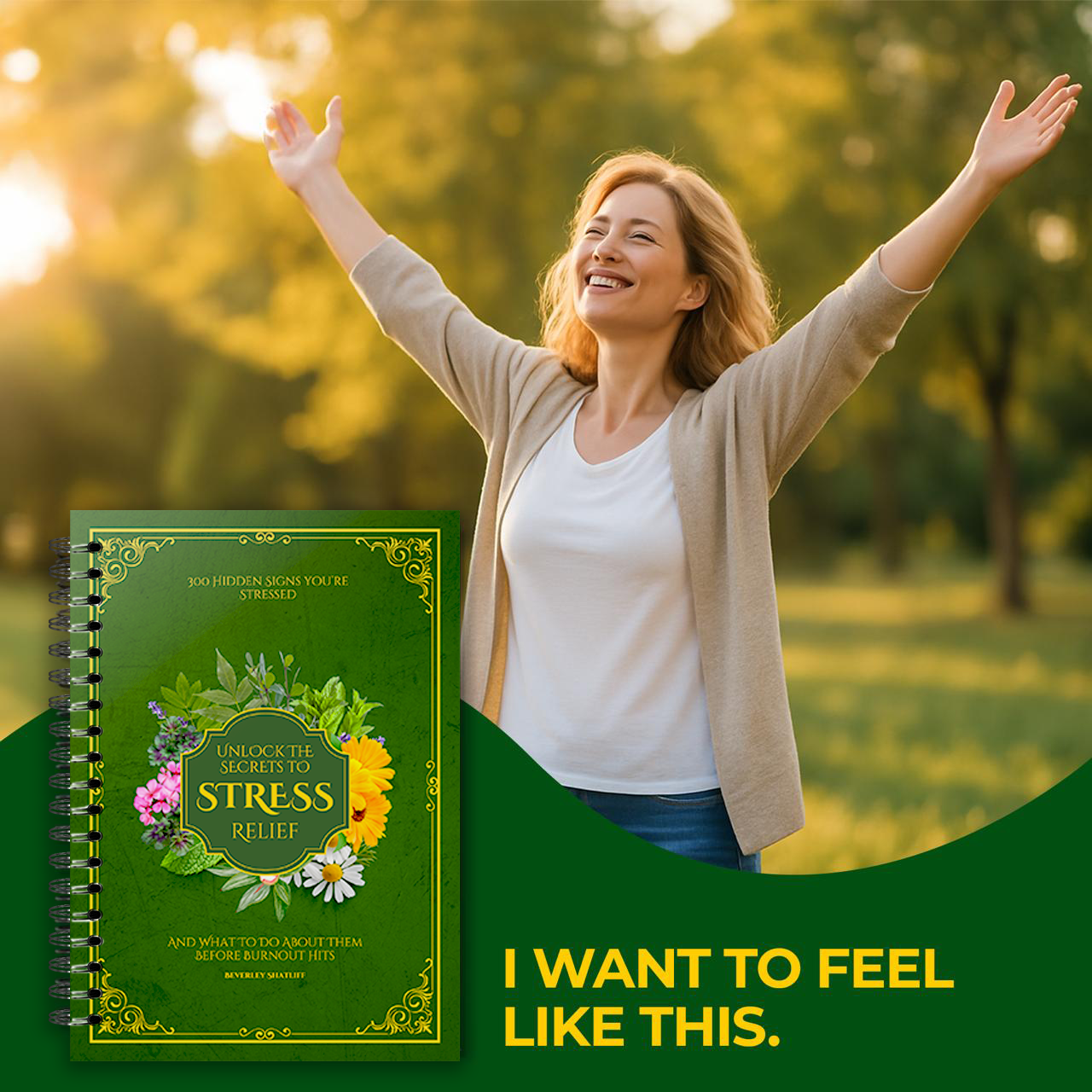
- Stopping the internal self-prosecution: "I'm not lazy. I'm overloaded. There's a difference."
- Being able to name what's happening, which takes away some of its power over you.
- Responding to stress signals earlier, before they escalate into moments you deeply regret.
- Feeling less alone inside your own experience because the guide finally puts language to things you thought were just yours.
- Having mental space again. Not perfect peace. Just enough quiet to feel present with the people you love.
- Beginning to feel, in small moments, like yourself again.
Underneath every symptom, every snapping incident, every guilt spiral, underneath all of it, this is what the woman carrying hidden stress actually wants.
"I want myself back."
Not a better version. Not an optimised version. Just the version that feels patient, present, clear, warm, and recognisably herself. The version that existed before the invisible stack got too high.
That version is not gone. She's just been buried under signals that nobody helped her read.
Special Introductory Offer
Everything you need to spot the hidden signs, stop the self-blame, and start taking small steps back to yourself, before burnout takes more than it already has.
"Fabulous book that really opened my eyes about the signs and stages of stress. Lovely concept with lots of easy-to-dip-into tips. All women I know need this book. Highly recommended."
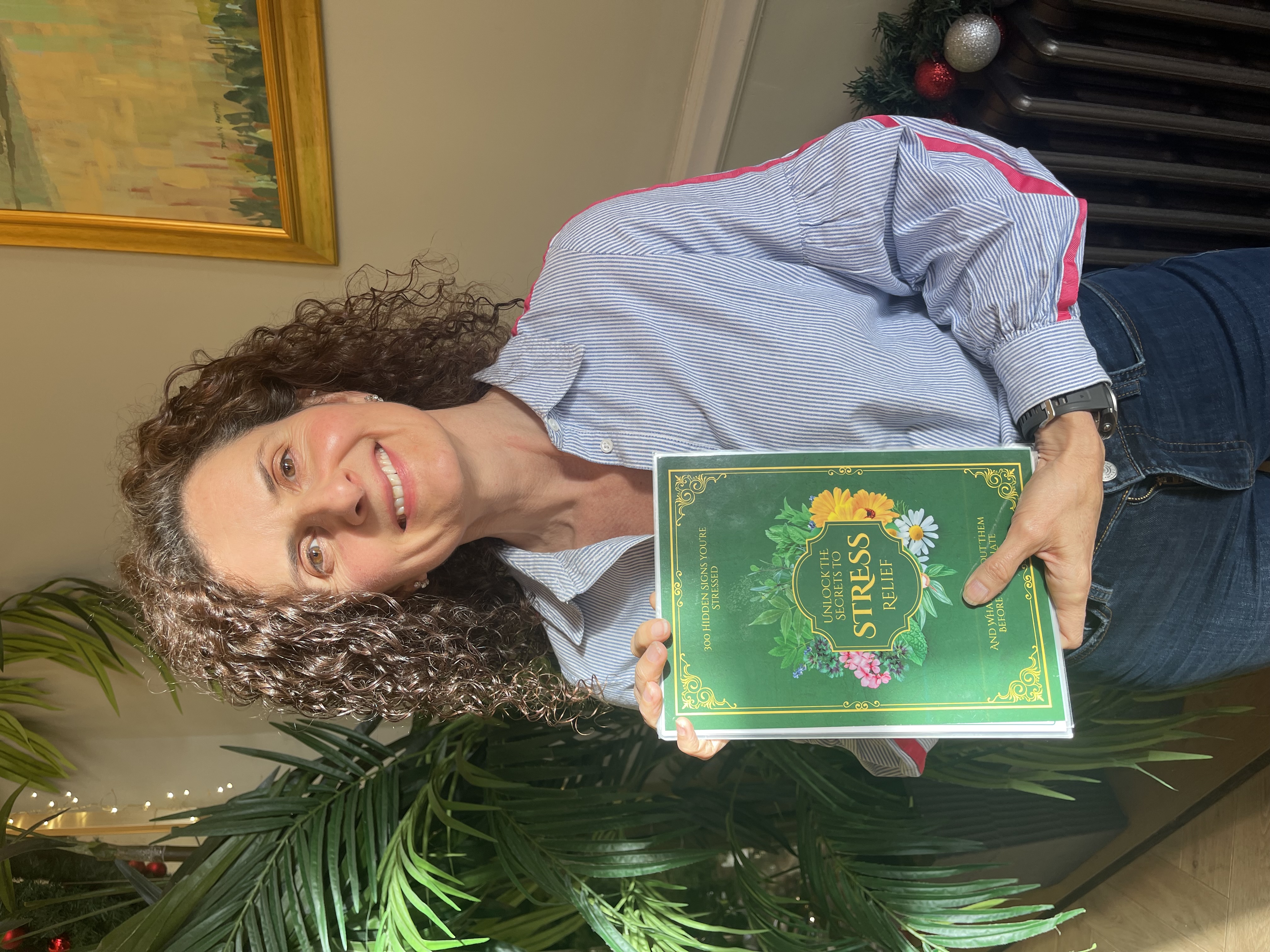
"This book helped me recognise stress in ways I'd never considered, with warmth, clarity, and practical support. Each page feels like a quiet nudge back to myself."
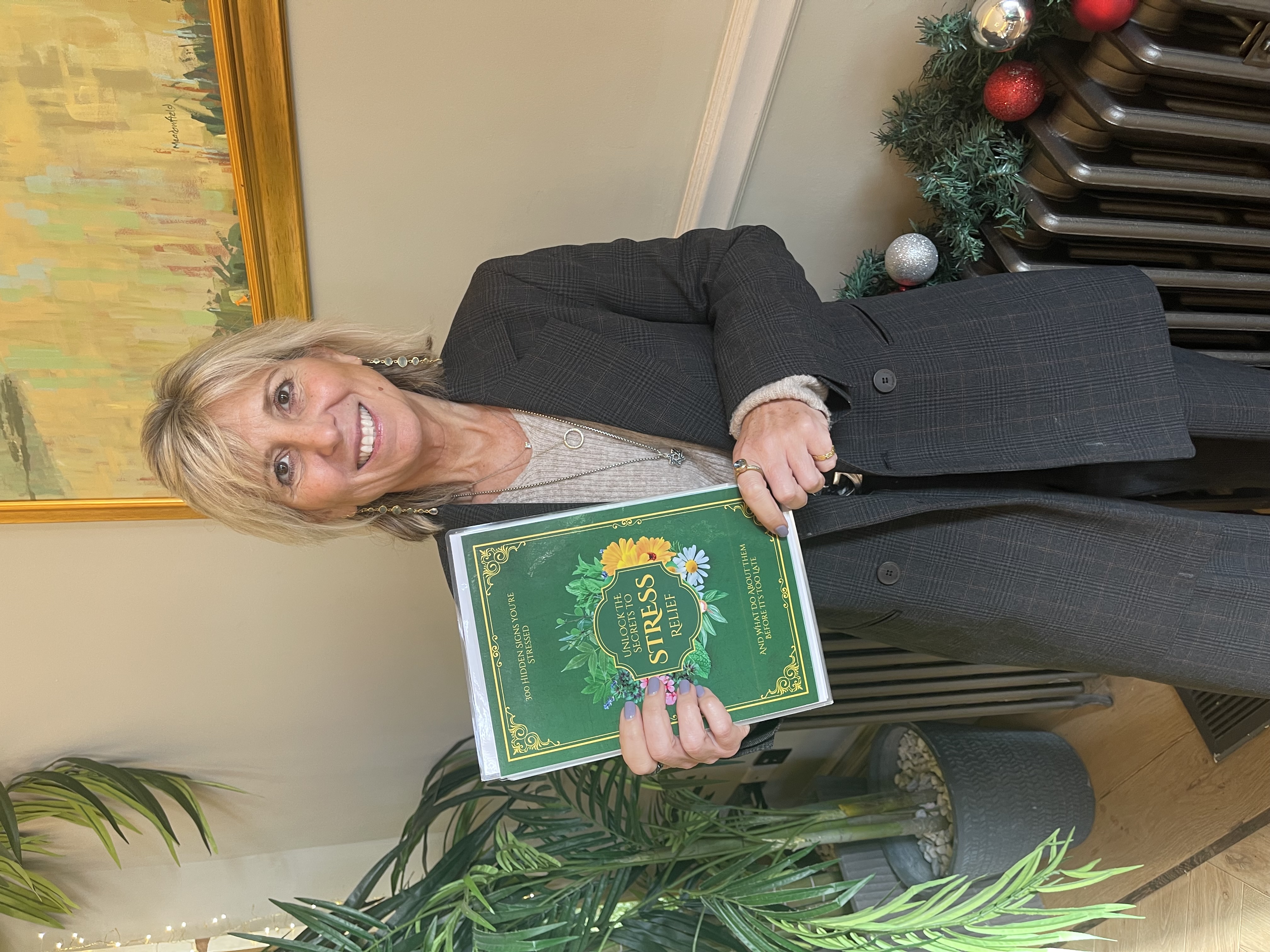
Read the guide. Work through the signs that apply to you. If you don't feel that it's helped you understand your stress patterns more clearly, simply send an email within 365 days for a full refund, no questions asked. The risk is entirely ours. The only thing you have to lose is the confusion.
One Last Thing, For the Woman Who's Still Not Sure She Deserves This
There's a particular kind of woman who will read everything on this page, recognise herself in every single line, feel the relief of finally being understood and then not act.
Not because she doesn't believe it would help. But because some quiet part of her still believes she hasn't earned it yet. That she needs to be worse off before help is justified. That other people have it harder.
That thought, I'm not burned out enough to deserve help, is itself one of the 300 signs.
You do not need to be at the bottom to begin the climb back. You do not need to wait until you've snapped one more time, lost one more connection with your child, stared one more time at the ceiling at 3am wondering where you went.
Your body has been whispering. The signs have been there. You just needed someone to help you read them.
That's what this guide does. Not perfectly. Not magically. But specifically, practically, and without adding one more thing to feel guilty about.
If you've read this far, you already know that something needs to change. The only question is whether you act on that knowledge now or wait until your system forces you to.
You've waited long enough.
Get Instant Access Today
300 hidden signs, the Signal to Soothe Method, and five bonus guides, all for one low introductory price.